
Cathode Stripping Machines and Automation
Automated cathode stripping replaces manual judgement with servo control, but throughput, blank protection and crane handshaking must be designed together.
The stripping bay sits between the electrolysis cell house and the melt shop, and it is where a deposited cathode sheet leaves the permanent stainless blank. Manual stripping relies on an operator levering each sheet free, so pace and blade angle change with the shift. Automating that operation is not only a labour question: the stripping head, the cathode support and the crane handshake have to be designed as one system before any throughput figure means anything. This article works through the choices in the order a project meets them.
Manual Versus Automated Stripping
On a manual line an operator levers the deposited sheet away from the stainless blank and drops it onto a take-away conveyor. Force and angle vary with the operator, and the permanent cathodes absorb that variation; over time the blank bows, the lugs bend and the plate hangs less true in the cell. Automation replaces that judgement with a fixed blade path, a controlled stripping force and a detection loop that interrupts the cycle when a sheet does not release as expected. The gain is repeatability first and speed second.
Robotic Unit or Dedicated Machine
The choice is not robot versus no robot; both routes take the operator out of the sheet path. They differ in how the motion is generated. A dedicated stripper sequences its motions with cams or hydraulics and repeats one cycle. The Robotic Cathode Stripping Unit generates the path with servo motors that give millimetre-level positioning and millisecond response across 7-axis synchronised motion, with stripping head speed adjustable from 0 to 999 mm/s. ZXSZ builds that unit with a servo plus pneumatic drive for clean production, on a compact frame of reduced height that keeps maintenance access simple.
| Criterion | Robotic Cathode Stripping Unit | Dedicated fixed-cycle stripper |
| Motion source | Servo plus pneumatic drive | Cam or hydraulic sequence |
| Head speed | Adjustable 0 to 999 mm/s | Fixed by machine cycle |
| Axes | 7-axis synchronised motion | Single or few axes |
| Cathode protection | Closed-loop detection, composite knife | Set by stop position and knife |
| Format change | Program and tooling change | Mechanical re-setting |
| Maintenance access | Compact frame, reduced height | Depends on frame design |
| Rated capacity | 700 sheets/h | Sized per line requirement |
Two rows of the table deserve closer reading. The composite knife material is specified so the knife strips the sheet without touching the stainless cathode, and the knife path is arranged so it never interferes with the contact bar. Both details protect the permanent blank rather than the product sheet, which is where the recurring cost of poor stripping sits. Ask for the knife geometry to be explained against your own cathode sample instead of a general arrangement drawing.
Throughput and Line Balance
The Robotic Cathode Stripping Unit is rated at 700 sheets/h. That is a machine capability measured under a continuous feed of correctly presented cathodes, not the output of the bay. Bay output is set by whichever element is slowest: crane delivery, the presentation conveyor, the removal of stripped sheets, or the stripper. Before accepting 700 sheets/h in a schedule, put the crane cycle and the take-away route on the same time base.
Buffer capacity is the usual remedy. An accumulation conveyor between the crane handover point and the stripper lets the crane work in batches while the stripper runs continuously. Size the buffer for the batch the crane actually delivers rather than for an average rate. On the anode side of the same circuit, the Anode Shaping Machine is rated at 350–450 plates/h; that figure counts anode plates, not cathode sheets, so cell-house and stripping-bay rates are never directly comparable.
Protecting Cathode Quality
Sheet quality and blank quality are separate objectives. For the sheet, the concerns are edge tearing, knife marking and incomplete separation. For the blank, they are bow, lug deformation and contact bar bending, all of which disturb plate spacing and current distribution in the cell. Closed-loop detection on the stripping head keeps deformation of permanent stainless cathodes to a minimum because the cycle reacts to the force it meets instead of pushing through a fixed stroke. That behaviour, not head speed, is what separates a controlled strip from a fast one.
Spacing discipline on the anode side sets the field that each cathode sees. The Anode Shaping Machine holds the centre distance between like-polarity plates at a stable 100 mm, measures thickness at 9 key points during shaping and rejects plates that fall outside the preset values; 95% of its anodes finish within 3 mm of vertical. Judge stripping performance only on a cell built to those tolerances, otherwise the stripping data describes the cell, not the machine.
Crane and Conveyor Integration
The stripping unit is a slave to the crane in most layouts, and the handshake is where projects slip. Specify what the stripper does when the crane arrives early, when it arrives late and when it presents a cathode the gripper has not seated properly. The signals are simple, covering gripper closed, cathode present, stripper ready, buffer full and fault, but the logic that resolves them decides whether the bay runs or alarms. Test that logic on a single crane cycle before the interlock schedule is frozen.
Downstream equipment makes the same demand. The Spent Anode Washing Unit reads residual anode slime with sensors and uses the reading to control feed-water pump speed and spray pressure in the washing chamber, so it needs anode identity and position from the same handling system that serves the stripper. Treat the stripping bay, the crane and the washing unit as one control domain with one set of position references.
Before You Specify
The actionable rule is sequence: fix the cathode format and the crane cycle first, then pick between the Robotic Cathode Stripping Unit and a dedicated fixed-cycle machine on how often the format changes. A stripper rated at 700 sheets/h cannot lift a bay whose crane delivers slower, and a controlled blade path protects the permanent stainless cathodes only if the rejection logic is specified before the PLC program is written.
Related equipment
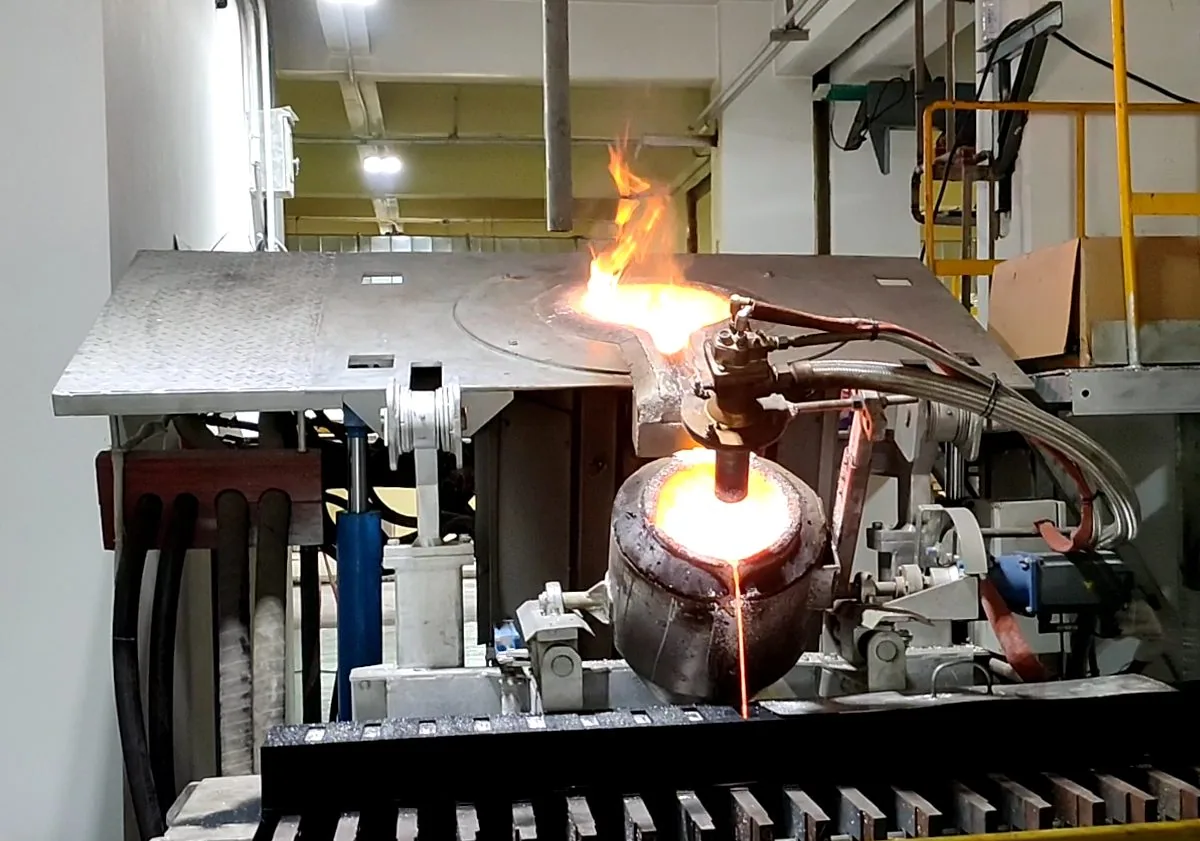
Linear Silver Ingot Casting Machine
For pure silver ingot producers, casting 15 kg ingots: silver powder melting, deoxidation, casting, post-treatment (washing, grinding, marking) and palletising in one line.
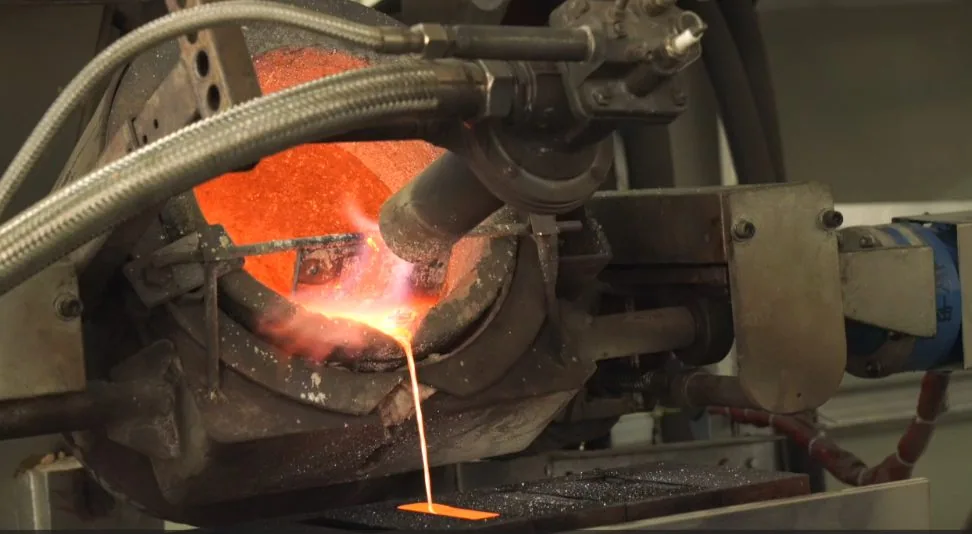
Linear Silver Ingot Casting Machine (15 kg / 30 kg Dual-Purpose)
One machine, two ingot sizes.
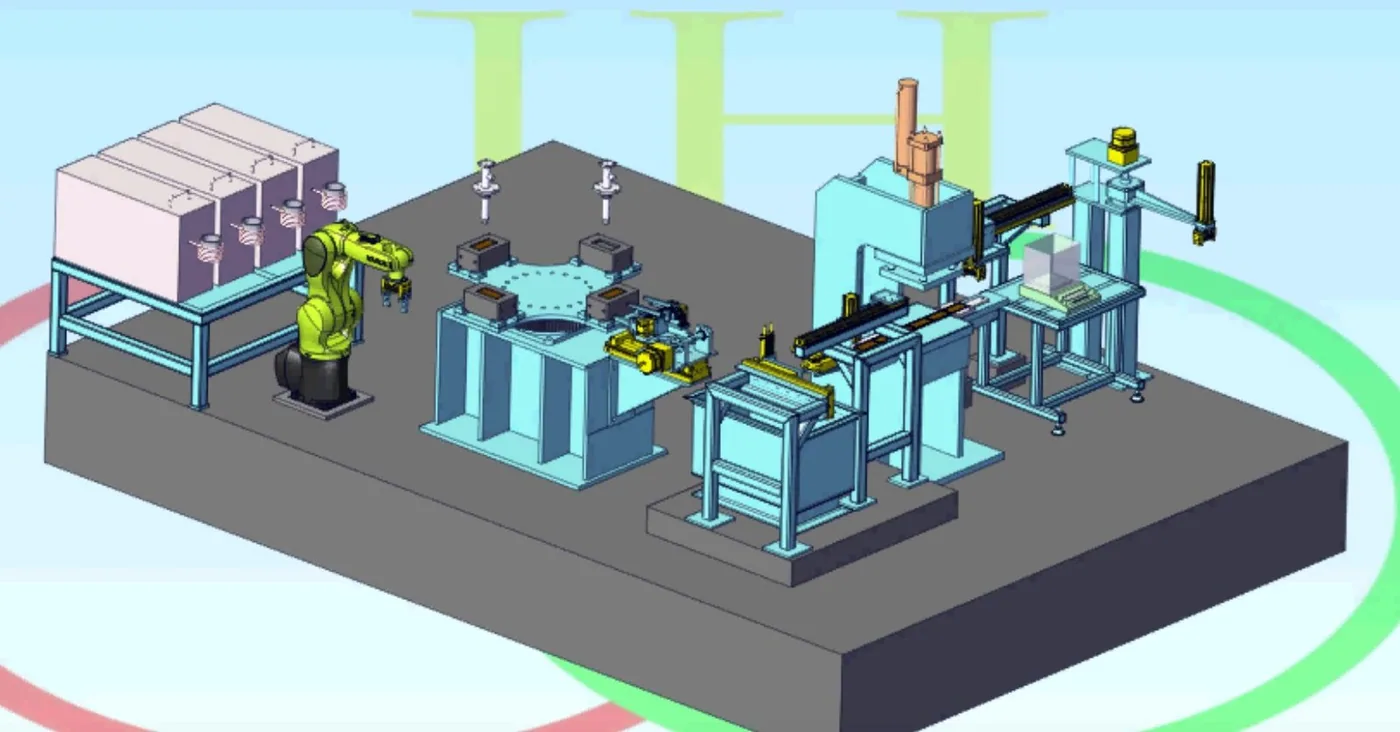
Automatic Gold Ingot Casting Machine
Automated equipment for precious-metal casting, using vacuum or pressure technology for loss-free, oxidation-free ingot forming.
Send us your specification
Tell us the metal, anode or ingot weight, and required output. An engineer will reply within one business day with a configuration and a quotation.