
Silver Refining Equipment Line for Ingot Casting
Size the furnace and casting machine as one chain before fixing ingot weight, since one mismatched station caps the whole silver refining line's output
Process Chain Overview
A silver refining line is a chain of five stations and the powder path decides the layout. Electrolytic silver powder enters the washing, drying and discharge system, leaves at below 3% moisture, and moves by vacuum to the melting furnace. The furnace melts under nitrogen, the casting machine doses the melt into the mould at a fixed point, and the demoulding and post-treatment stations cool, polish, mark, weigh and stack the product. Every transfer between stations is a place where oxidation, spillage or temperature loss can begin, so the conveying layout deserves as much attention as the machines.
ZXSZ, the brand of Ganzhou Jinhuan Casting Equipment Co., Ltd., builds these stations as separate modules, so a refinery can replace the casting machine without touching the washing and conveying side. That modularity matters when the feed changes. The Silver Granulation System melts electrolytic powder under nitrogen, quenches it to Ø2–5 mm granules and delivers 2 t per 8 h; a line sized around dry powder behaves differently once granulation sits upstream, because granules feed the furnace more evenly and lose less to dust.
Furnace and Casting Machine Matching
Furnace capacity across the silver range runs from 500 to 4,000 kg, and that figure has to be read against the casting machine's hourly rate rather than against its own batch size. A 2.0 t/h machine such as the Linear Horizontal Silver Anode Casting Machine empties a small furnace faster than the furnace can refill it, which creates waiting time between casts. The reverse mismatch is worse: an oversized furnace holds a large melt at temperature while a slow machine draws it down in 11–45 kg steps. Match the melt inventory to the casting cycle, not to the shift.
Mould format drives the match as much as tonnage. The Vertical Rotary Silver Anode Casting Machine (Generation II) carries four or more mould stations on a disc and allows 10 t of continuous silver output; the Linear Silver Ingot Casting Machine runs a casting cycle of 2 minutes or less per ingot on a caterpillar-type mould train. The two behave differently when a pour is interrupted: a disc indexes each mould to the fixed pour point and can skip a suspect cavity, while a linear train usually has to clear the row before restarting.
Ingot Weight Options
Weight is set by the downstream step, not by the machine. A refinery feeding a silver electrorefining circuit casts anodes anywhere in the 11–45 kg band, which the Vertical Rotary Generation I and Linear Horizontal machines both cover; where one plate weight is wanted, the Generation II machine holds 17 ± 1 kg. Ingot producers work in 15 kg units, at 15 ± 1 kg on the Linear Silver Ingot Casting Machine and at 15 kg to GB/T 4135—2016 dimensions on the Vertical Rotary Silver Ingot Casting Machine. All four are fixed-point casting under automatic PLC control with ±1 kg accuracy.
| Machine | Unit weight | Mould format | Typical fit |
| Vertical Rotary Generation I | 11–45 kg | Vertical mould single pass | Smaller refineries |
| Vertical Rotary Generation II | 17 ± 1 kg | Disc with 4+ stations | Large refineries |
| Linear Horizontal Anode | 11–45 kg | Caterpillar-type moulds | Continuous plate output |
| Linear Silver Ingot | 15 ± 1 kg | Linear mould train | Ingot lines |
| Vertical Rotary Ingot | 15 kg | Disc with 4+ stations | Frequent mould changes |
Anode profile and ingot geometry are fixed before the machine order, not after. Anode lifting lugs are formed in a single pass — double lugs on the Generation I machine, single or double eyelet on the Generation II — so the mould cavity must be cut to the crane and cell configuration. Ingot dimensions follow GB/T 4135—2016 on both ingot machines, with dimensional error held within 1 mm and a surface that needs no re-melting; mould changes on the disc machine take 5 minutes or less, which matters when a trading order switches between standard and custom ingots.
Automation and Safety
Automation level separates the two ends of the range more sharply than any other decision. The Generation I machine leaves ladle tilt, disc indexing and mould open/close with the operator, which suits a site with limited technical resources and keeps the control philosophy simple. From the Generation II machine upward, dosing, casting, cooling, stripping, conveying and palletising run without manual intervention under PLC control with configurable pouring speed and cooling time. The step change is not the control hardware but the removal of the operator's judgement from the cooling window, which is where weight and surface defects are decided.
Safety features track the material rather than the machine. Closed-loop water cooling keeps steam out of the cooling zone on the Generation II disc machine, and inert gas protection holds silver oxidation loss below 0.3% on the ingot line. The Silver Granulation System adds over-temperature, over-pressure, over-current and cooling-system protection with interlocks against misoperation, and it can be supervised remotely on 3-megapixel cameras. On the conveying side, vacuum of −0.06 to −0.095 MPa is adjusted dynamically and pressure sensors watch blockage risk with at least 95% fault-diagnosis accuracy.
Capacity Sizing
Sizing starts from the 8-hour shift rather than the annual figure. Ingot lines deliver 1.5–2 t per 8 h on the linear machine and at least 1.8 t per 8 h on the vertical rotary machine; granulation delivers 2 t per 8 h; anode casting is rated hourly, at 2.0 t/h when running 45 kg plates at 45 plates per hour, or above 120 plates per hour at 17 kg. Convert the refinery's daily silver release into a shift figure, then derate it for mould changes, ladle maintenance and furnace relining before comparing machines.
| Parameter | Recorded value |
| Furnace capacity | 500–4,000 kg |
| Anode weight range | 11–45 kg |
| Weight accuracy | ±1 kg |
| Ingot line output | 1.5–2 t per 8 h |
| Vertical ingot output | ≥1.8 t per 8 h |
| Granulation output | 2 t per 8 h |
Fix the key figures before requesting a quotation: the daily silver release in kilograms, the unit weight the electrorefining cell or trading step will accept, and the casting hours actually available per shift after maintenance. Those define furnace capacity, machine format and automation level, in that order, because the furnace tolerates a longer wait than the casting cycle does. Where the figures conflict, keep the casting machine's hourly rate and let the furnace carry a slightly larger melt; a stalled cycle misses its cooling window and costs more than an idle furnace.
Related equipment
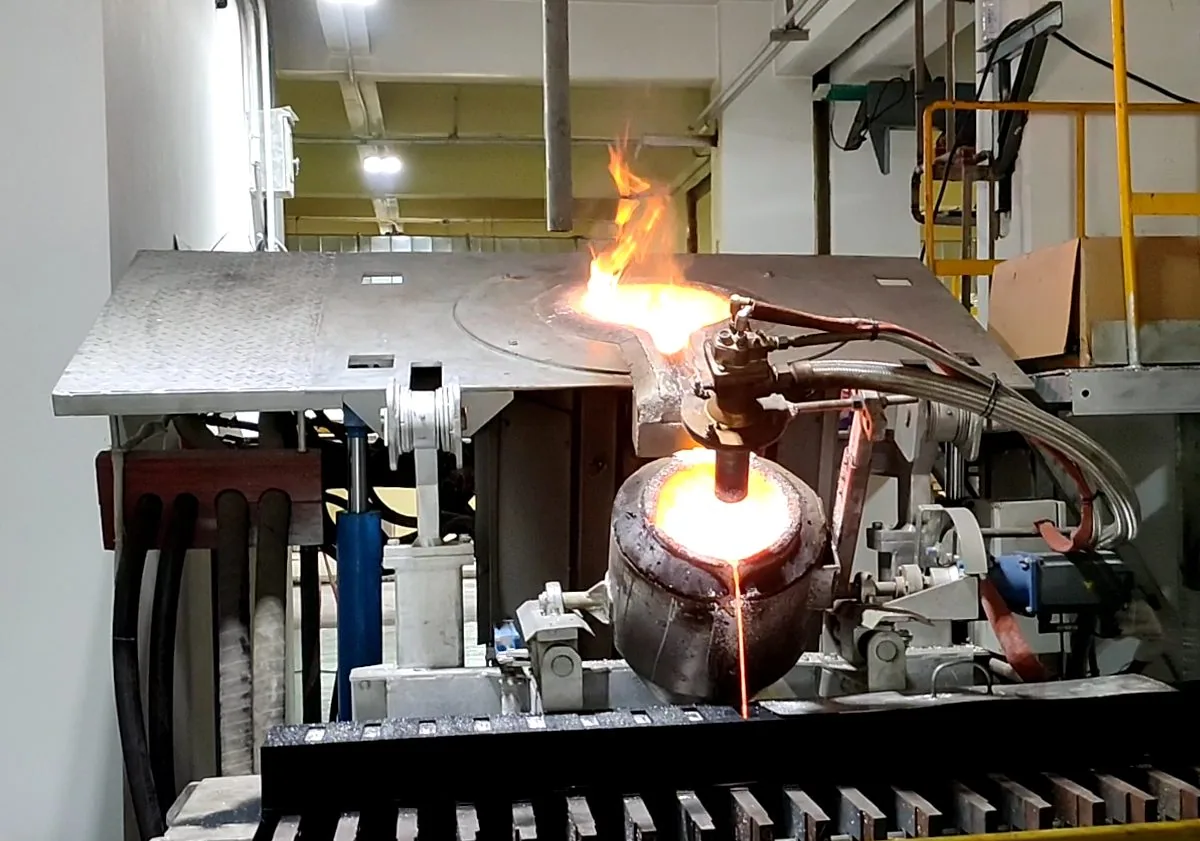
Linear Silver Ingot Casting Machine
For pure silver ingot producers, casting 15 kg ingots: silver powder melting, deoxidation, casting, post-treatment (washing, grinding, marking) and palletising in one line.
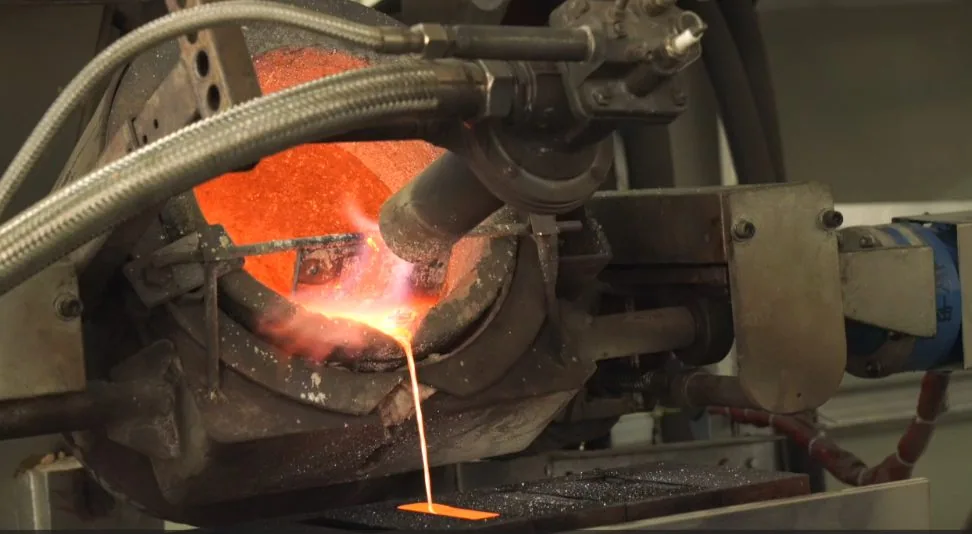
Linear Silver Ingot Casting Machine (15 kg / 30 kg Dual-Purpose)
One machine, two ingot sizes.
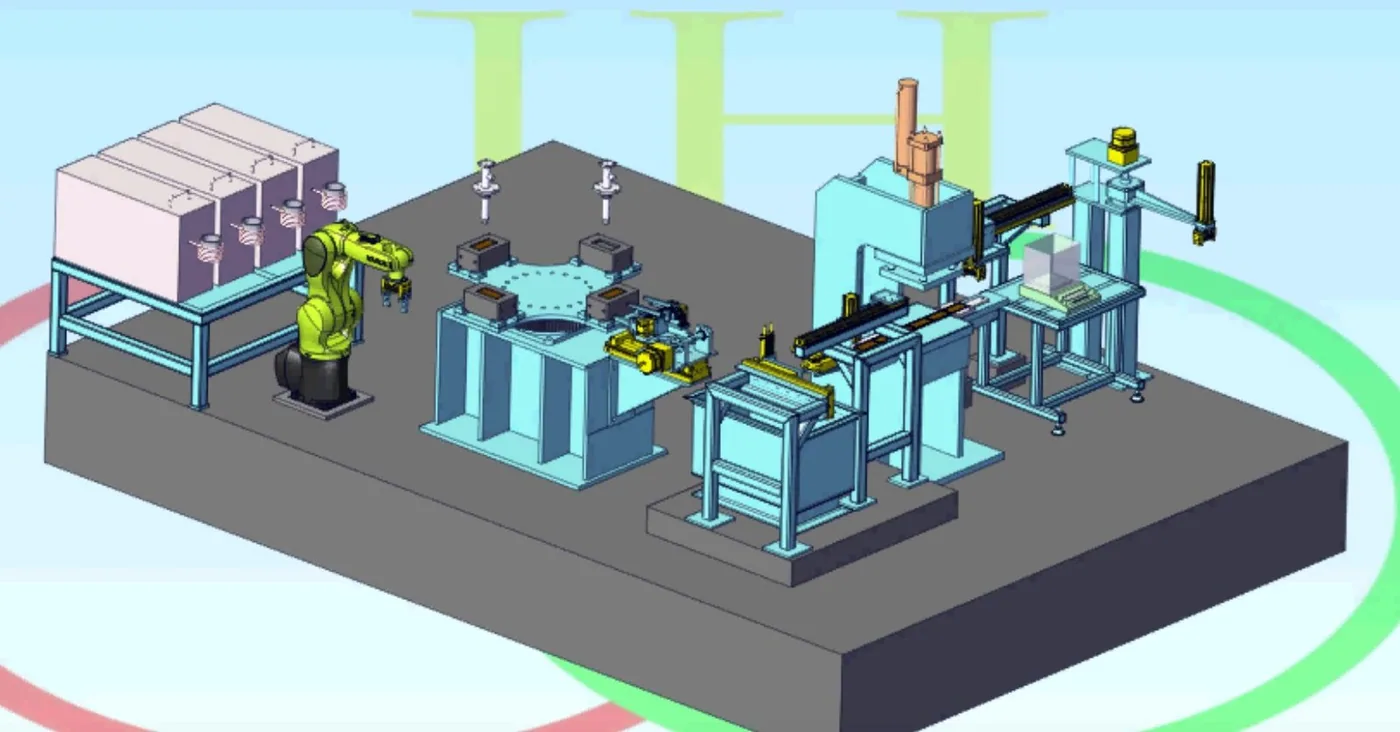
Automatic Gold Ingot Casting Machine
Automated equipment for precious-metal casting, using vacuum or pressure technology for loss-free, oxidation-free ingot forming.
Send us your specification
Tell us the metal, anode or ingot weight, and required output. An engineer will reply within one business day with a configuration and a quotation.